
Virtual executive assistant cost in 2026 ranges from $5 to $20 per hour for offshore talent in Southeast Asia, $15 to $30 per hour for Latin American professionals with US time-zone alignment, and $35 to $75 per hour for US-based C-suite-level practitioners; through managed service providers and specialist agencies, structured monthly retainers typically run $1,500 to $6,000 depending on dedicated hours, scope complexity, and experience tier. The total cost of ownership extends meaningfully beyond the invoice rate: onboarding investment, management overhead, tool provisioning, and the productivity ramp-up period all contribute to the true financial picture. Executives who evaluate this investment on headline hourly rate alone consistently underestimate both the cost of a poor-fit engagement and the compounding return delivered by a high-performing virtual executive assistant.
Most pricing guides hand you a number range and stop there. This one gives you the full architecture of the cost: every variable that moves the number, every hidden expense most executives miss, every model compared side by side, and the ROI framework that makes the investment case clear.
Whether you’re evaluating your first VEA hire or reassessing an existing arrangement, this breakdown covers what the total cost actually looks like from day one through year one.

Executives who want transparent pricing anchored to real executive workflows – not abstract hourly estimates – can explore dedicated virtual executive assistant support options through GPERO, where cost structures are designed around measurable executive outcomes rather than billable hour counts.
Why Virtual Executive Assistant Pricing Looks So Confusing
Search “virtual executive assistant cost” and you’ll encounter a disorienting spread. Some providers quote $5 per hour. Others quote $75. A managed service retainer might reach $6,000 per month. A freelance listing shows availability at $18 per hour. All of these numbers are technically accurate for some configuration of the service – and none of them are useful without context.
The confusion exists because most pricing discussions fail to separate four distinct variables that each move the number independently:
Geography and labor market
The wage differential between US-based, Latin American, and Southeast Asian VEAs is significant and stems from real structural differences in local market rates – not simply from quality differences.
Experience tier and scope complexity
A VEA managing basic scheduling operates at a fundamentally different level than one handling C-suite communications, board correspondence, and multi-stakeholder project coordination. These roles carry different rates.
Hiring model
Direct freelance hires, specialist agencies, and managed service providers each carry different cost structures, risk profiles, and total cost of ownership implications.
Engagement format
Hourly pay-as-you-go, part-time retainer, and full-time dedicated arrangements deliver different effective rates and very different operational outcomes.
Separating these four variables is the only way to make sense of any price you encounter in this market.
Virtual Executive Assistant Cost by Geography: Market Rates
Geography is the primary driver of headline rate variation. Here is a clear-eyed breakdown of current executive-level VEA rates across the three major talent geographies.
US-Based Virtual Executive Assistants
US-based VEAs command the highest rates in the market. This reflects domestic wage expectations, regulatory compliance, and the benefit of complete native time-zone alignment for real-time executive support.

Current market rate range: $35 to $75 per hour
How that range breaks down in practice:
$35 to $50/hour
Experienced VEAs with 3 to 5 years of direct executive support history; strong written communication; proficient in standard tool stacks such as Google Workspace, Asana, and Salesforce
$50 to $65/hour
Senior practitioners with 5 to 8 years supporting C-suite or VP-level principals; demonstrated capability in board correspondence, stakeholder management, and travel logistics at scale
$65 to $75+/hour
Elite-tier VEAs with 8+ years at C-suite level; specialized industry knowledge; chief-of-staff-adjacent strategic capability; discretionary judgment on high-stakes executive communications
Latin American Virtual Executive Assistants
Latin American talent markets – particularly Colombia, Mexico, Argentina, and Brazil – represent the fastest-growing segment of the professional VEA market for North American executives. High English proficiency, US business-hours time-zone overlap, strong university-educated professional talent pools, and a mature understanding of North American business culture make this geography increasingly attractive.
According to 2026 salary benchmarking data from Howdy, all-in annual costs for Latin American executive assistants range from approximately $20,000 to $55,000 depending on seniority – representing a compelling cost-to-capability ratio compared to equivalent US hires.
Current market rate range: $15 to $30 per hour
$15 to $20/hour
Experienced VEAs with solid executive support backgrounds, strong business English, and proficiency in standard executive tool stacks
$20 to $30/hour
Senior professionals with direct C-suite exposure, polished written English, and experience managing external stakeholder communications on behalf of executives
Full-time annual equivalent
$31,200 to $62,400
Southeast Asian Virtual Executive Assistants
The Philippines and India remain the largest sources of offshore executive assistant talent globally. Rate advantages are substantial. Executives should factor in the time zone differential (typically an 11 to 13 hour offset from US Eastern time), which affects real-time communication availability, and consider the additional investment required to bring a Southeast Asian VEA to C-suite communication standards.
Current market rate range: $5 to $20 per hour
$5 to $10/hour
Competent administrative support with solid English skills; best matched to structured, clearly defined tasks with explicit instructions
$10 to $20/hour
Experienced executive-level VEAs with verifiable C-suite exposure, strong written communication, and complex workflow experience
Full-time annual equivalent
$10,400 to $41,600
Virtual Executive Assistant Cost by Hiring Model
Beyond geography, the hiring model shapes both direct cost and risk-adjusted total cost of ownership. Three primary models serve the VEA market, each with distinct economic tradeoffs.

Model 1: Direct Freelance Hire
You source and contract a VEA directly through platforms such as Upwork, LinkedIn, or professional referral networks. All vetting, contracting, onboarding, and relationship management sit entirely with you.
Direct hourly cost:
- US-based: $30 to $70/hour
- Latin American: $12 to $28/hour
- Southeast Asian: $5 to $18/hour
Additional cost factors to budget separately:
- Platform transaction fees: 3% to 10% of invoiced amounts on most freelance marketplaces
- Vetting time investment: 15 to 40 hours of executive time to source, assess, interview, and select a qualified candidate at the C-suite level
- Onboarding time investment: 10 to 20 hours in the first 30 days to establish workflows, transfer context, and calibrate communication standards
- Replacement cycle cost if the hire underperforms: a full restart of vetting and onboarding, typically consuming 1 to 2 months of the original VEA’s cost equivalent in lost executive time and productivity
Best for: Cost-sensitive operators with the time, hiring expertise, and risk tolerance to run a rigorous self-directed selection process.
Model 2: Specialist Executive Assistant Agency
Specialist agencies handle candidate sourcing, vetting, matching, and replacement on your behalf. They maintain a pre-screened roster of executive-level VEA candidates and match based on scope requirements, working style, and industry context.
Direct cost profile:
- Monthly retainer: $2,500 to $6,000 per month for full-time dedicated C-suite support
- Effective hourly equivalent: $35 to $75/hour depending on hours committed
- Placement fee model (for permanent hires): 15% to 25% of the first year’s annualized cost
What the agency premium covers:
- Pre-vetted candidates who have already cleared competency assessments and reference verification
- A replacement guarantee if the initial match does not meet performance standards
- Reduced executive time investment in the sourcing process: typically 2 to 5 hours rather than 15 to 40
- Ongoing accountability infrastructure and support for performance issues
Best for: Executives with complex scope requirements who cannot absorb the time cost of a self-directed search and value the structural risk mitigation of a guaranteed replacement.
Model 3: Managed Executive Assistant Service
Managed services provide the most comprehensive cost and operational structure. The provider employs the VEA directly, manages all HR, benefits, tools, and quality assurance, and delivers fully operational executive support as a service.
Direct cost profile:
- Monthly retainer: $1,500 to $4,500 per month for part-time to full-time dedicated support
- Full-time annual equivalent: $18,000 to $54,000
- Many providers offer tiered packages based on committed hours per month rather than fixed full-time schedules
What the managed service fee includes:
- Direct employment of the VEA – no contractor management, tax complexity, or HR overhead on your side
- Backup coverage continuity when the primary VEA is unavailable due to illness or leave
- Ongoing quality monitoring, performance management, and regular check-ins by the service provider
- Tool stack and infrastructure provided by the service, reducing your software cost
- Seamless replacement without a productivity gap when personnel changes occur
Best for: Scaling executives and leadership teams who want predictable monthly pricing, zero HR overhead, and built-in operational redundancy.
Virtual Executive Assistant Cost: Full Comparison Table
| Factor | Direct Freelance | Specialist Agency | Managed Service |
|---|---|---|---|
| US-based hourly rate | $30 – $70/hr | $40 – $75/hr | Included in retainer |
| LATAM hourly rate | $12 – $28/hr | $18 – $35/hr | Included in retainer |
| SEA hourly rate | $5 – $18/hr | $10 – $22/hr | Included in retainer |
| Typical monthly cost (full-time) | $800 – $1,200 | $2,500 – $6,000 | $1,500 – $4,500 |
| Executive vetting time | 15 – 40 hours | 2 – 5 hours | 1 – 2 hours |
| Onboarding burden | High | Medium | Low |
| Replacement guarantee | None | Usually yes | Yes |
| Monthly management overhead | 5 – 8 hours | 2 – 4 hours | 1 – 2 hours |
| Tool and software cost | Separate | Varies | Usually included |
| HR and tax complexity | Executive manages | Varies | Provider manages |
| Best for | Cost-sensitive, time-rich | Complex requirements | Scaling executives |
Virtual Executive Assistant Cost by Engagement Structure
Engagement structure determines the effective hourly rate you pay and has major implications for how quickly the VEA builds the contextual intelligence needed to work proactively.

Hourly Pay-As-You-Go
You pay only for hours worked with no minimum commitment. This structure suits executives with variable, project-based, or low-volume support needs.
Effective rate
Full published hourly rate, no volume discount
Monthly cost range
Fully dependent on hours used; typically $500 to $3,000 for light to moderate use
Best for
Early-stage operators testing the VEA model before committing to dedicated support
Limitation
No continuity of service, limited ability to build proactive situational awareness, and typically lower priority when the VEA serves multiple concurrent clients
Part-Time Monthly Retainer
You commit to a fixed number of hours per month – typically 40 to 80 hours – at a slightly discounted effective hourly rate. This structure provides consistent daily availability without a full-time cost commitment.
Effective rate
5% to 15% below pay-as-you-go rates, due to committed volume
Typical monthly investment
$600 to $4,500 depending on geography, model, and hours
Best for
Executives who need consistent daily touchpoints but do not yet have a full-time delegation workload built out
Full-Time Dedicated Retainer
You secure 160 or more hours per month of dedicated support from a single VEA. This structure produces the deepest working relationship, the most proactive operational performance, and the best effective rate per hour.
Effective rate
15% to 25% below hourly rates, due to full volume commitment
Typical monthly investment
$2,000 to $9,600 depending on geography, model, and scope tier
Best for
CEOs and senior executives with consistent high-volume delegation across Tier 2 and Tier 3 functions including stakeholder management, research, and project coordination
The Hidden Costs of Virtual Executive Assistant Engagement
The headline rate tells approximately 65% of the financial story. The remaining 35% lives in costs that never appear on an invoice but absolutely appear in your time budget and productivity outcomes.
Hidden Cost 1: Executive Time for Management and Oversight

Even the most autonomous VEA relationship requires regular management input from the executive. Industry data consistently shows that an established VEA engagement requires 3 to 8 hours of executive management time per month for check-ins, feedback, course corrections, and priority calibration.
At a CEO’s effective hourly value of $150 to $300 per hour, this represents $450 to $2,400 per month in opportunity cost that never appears on the invoice.
During the onboarding phase – the first 30 to 60 days – this management overhead runs considerably higher, typically 8 to 15 hours per month as context is transferred and operational rhythms are established.
Hidden Cost 2: Onboarding Investment and Productivity Ramp-Up
A new VEA does not start at full productive velocity on day one. The ramp-up period before a high-performing VEA operates independently and proactively typically spans 30 to 60 days. During this window, most VEAs operate at 40% to 70% of their eventual efficiency.
For a full-time VEA at a $3,000 per month rate, this ramp-up period represents $900 to $1,800 in service cost during a window when you are receiving partial value. Add the executive time invested in onboarding documentation and context transfer, and the true cost of the first 60 days routinely exceeds the nominal invoice amount by 30% to 50%.
Hidden Cost 3: Tool and Software Access

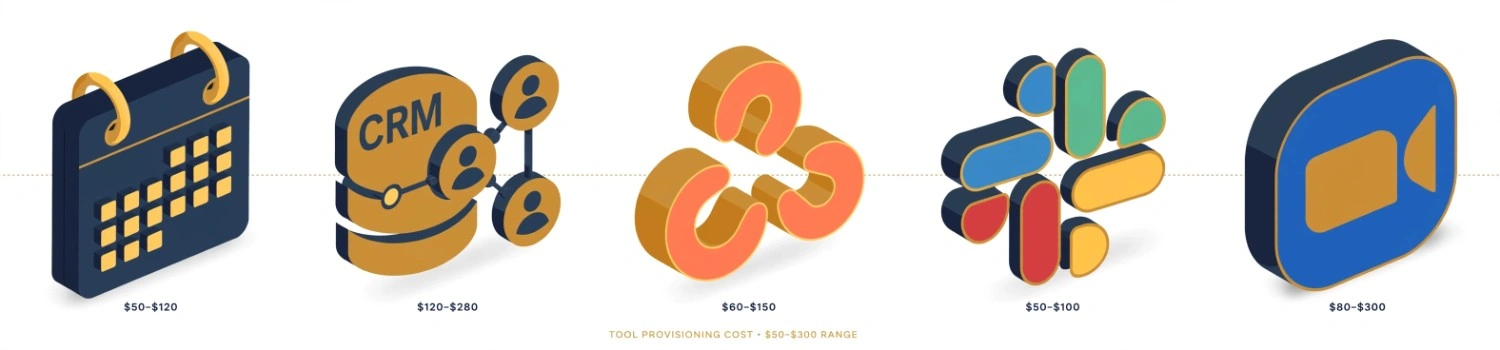
A functional VEA requires access to your operational tool stack. Depending on your platforms, this may include: calendar and email access (no additional cost if using existing seats), project management tools ($10 to $30 per month per seat), CRM access ($25 to $150+ per month depending on platform), communication platforms ($7 to $15 per user per month), travel booking platforms (variable), and video conferencing licenses.
Total tool provisioning cost typically adds $50 to $300 per month to the all-in engagement cost, depending on the complexity of your stack.
Hidden Cost 4: Replacement Cycle Expense

According to reporting in Entrepreneur magazine on the true cost of VA hires, direct freelance hires that fail – whether through underperformance, resignation, or scope mismatch – force a full restart of the sourcing, vetting, and onboarding cycle. This replacement cost typically amounts to 1.5 to 3 months of the original VEA’s rate in recovered executive time, lost institutional knowledge, and re-onboarding investment.
In a direct freelance model, this risk sits entirely with the executive. In an agency or managed service model, it is transferred to the provider through the replacement guarantee.
Hidden Cost 5: Communication and Coordination Friction
Particularly in offshore engagements with significant time zone gaps, asynchronous coordination creates friction costs that rarely get quantified. Delayed responses, missed context, and misaligned expectations in the first 90 days routinely add 2 to 4 hours of weekly back-and-forth that would not exist in a well-aligned, real-time engagement.
For an executive valued at $200 per hour, even 2 hours of weekly friction cost represents $1,600 per month in opportunity cost – an amount that can close the gap between an offshore rate and a LATAM or US rate very quickly.
Virtual Executive Assistant Cost vs. In-House Executive Assistant: The Real Comparison

For many executives, the relevant comparison is not between VEA hiring models – it is between a virtual executive assistant and the cost of hiring a full-time, in-office executive assistant.
The numbers are striking. According to salary data from The Ladders, the average salary for an executive assistant in the US sits at approximately $99,000 per year, with C-suite-level EAs in major markets reaching $110,000 to $130,000.
But salary is only the starting point. A widely cited industry rule establishes that the fully-loaded cost of an employee runs 1.25 to 1.4 times base salary once employer payroll taxes, health insurance contributions, retirement matching, paid time off, equipment, office space, and HR overhead are included.
Here is the full comparison:
| Cost Component | In-House EA (Annual) | VEA – Managed Service (Annual) | VEA – Direct Freelance LATAM (Annual) |
|---|---|---|---|
| Base salary / service fee | $75,000 – $110,000 | $18,000 – $54,000 | $18,720 – $49,920 |
| Employer payroll taxes (FICA, FUTA) | $5,700 – $8,400 | None | None |
| Health insurance contribution | $6,000 – $12,000 | None | None |
| Retirement matching | $2,250 – $4,400 | None | None |
| Equipment and software | $2,500 – $5,000 | Usually included | $600 – $2,400 separate |
| Office space allocation | $4,000 – $12,000 | None | None |
| Onboarding and training | $3,000 – $8,000 | Reduced | $1,000 – $3,000 |
| Recruitment cost | $5,000 – $15,000 | Minimal | $500 – $2,000 |
| Estimated fully-loaded total | $103,450 – $174,800 | $18,000 – $54,000 | $20,820 – $57,320 |
| Estimated annual savings vs. in-house | – | $49,000 – $120,000 | $46,000 – $117,000 |
These figures illustrate why the virtual executive assistant cost model has become the default choice for a growing percentage of growth-stage and enterprise executives. The fully-loaded cost savings are not marginal; they are structural.
What You Get at Each Price Point: A Scope Reality Check
Price and scope align in the VEA market, but not always in the ways executives expect. Here is an honest breakdown of what each investment tier realistically delivers.

Under $1,500/month
At this price point, you are in the territory of part-time, offshore administrative support. Realistic deliverables include:
- Basic calendar management with clearly defined scheduling parameters
- Inbox sorting and filtering (not drafting or responding autonomously)
- Travel research and simple bookings with step-by-step instructions
- Data entry, document formatting, and structured research tasks
Realistic limitations include: time zone gaps requiring asynchronous-only workflows, limited judgment on complex or ambiguous tasks, and significant executive investment in onboarding and daily direction.
Best for: Founders at early stages who need administrative capacity, not executive-level judgment.
$1,500 to $3,000/month
This range covers the core of the managed service and mid-tier agency market. At this investment level, you can expect:
- Part-time to near-full-time availability depending on geography and model
- Autonomous inbox management with drafted responses for approval
- Proactive calendar management with conflict resolution capability
- Travel logistics handled end-to-end with minimal executive input
- Meeting preparation including basic briefing documents and agenda drafting
- Communication in the executive’s voice for routine stakeholder correspondence
This tier represents the sweet spot for most scaling founders and mid-market executives who need solid operational support without the full cost of a premium US-based engagement.
$3,000 to $6,000/month
At this investment level, you access the top tier of the managed service market or the core range of specialist agency pricing. Deliverables at this level include:
- Full-time dedicated support with real-time availability during business hours
- C-suite-caliber written communication in the executive’s voice for external stakeholders
- Complex multi-stakeholder coordination including board and investor correspondence
- Comprehensive project tracking and cross-functional coordination
- CRM management and relationship database maintenance
- Sophisticated research and executive briefing preparation
This tier is calibrated for CEOs, managing directors, and senior executives who need a trusted operational partner – not just administrative capacity.
$6,000+/month
Above this threshold, you are typically in the territory of highly specialized, US-based senior VEAs or chief-of-staff-adjacent managed support. At this level, expect:
- Strategic partnership capability beyond pure executive administration
- Deep institutional knowledge and long-term relationship continuity
- Autonomous decision-making within defined authority thresholds
- Stakeholder management independence, including high-stakes external communications
- Potential overlap with operations management or executive project leadership functions
Common Mistakes Executives Make When Evaluating Virtual Executive Assistant Cost

Mistake 1: Comparing Hourly Rates Across Different Scope Levels
A $15/hour rate for entry-level offshore administrative support and a $55/hour rate for a senior US-based C-suite VEA are not comparable numbers. Comparing them directly – and choosing the cheaper one for an executive-level role – produces consistent disappointment and wasted onboarding investment.
Always define the scope level you need first, then compare rates within that scope tier.
Mistake 2: Ignoring the Ramp-Up Cost in Budget Planning
Most executives calculate VEA cost as: rate multiplied by hours equals monthly budget. This calculation omits the productivity gap during ramp-up. Budget for the first 60 days at 60% productive capacity – factoring in the executive time investment in context transfer – to arrive at an accurate true cost for the first quarter of engagement.
Mistake 3: Choosing the Lowest Offshore Rate for Executive-Level Work
The rate floor in the Southeast Asian market is $5 per hour. That rate reflects the market value of structured administrative support, not C-suite executive partnership. When executives apply that rate to complex judgment-dependent work, they absorb the hidden cost in rework, miscommunication, friction overhead, and eventual turnover – often spending more than a mid-tier rate would have cost.
Mistake 4: Underestimating the Value of a Replacement Guarantee
Direct freelance hires carry no replacement guarantee. In a market where the true cost of a failed hire runs 1.5 to 3 months of rate equivalent in lost time and re-onboarding investment, the premium paid for an agency or managed service replacement guarantee is typically recovered on the first replacement cycle alone.
Mistake 5: Evaluating Cost Without Evaluating ROI
Virtual executive assistant cost is only meaningful in context of the value generated. An executive who pays $3,500 per month for a VEA who recovers 20 hours of executive time per week – time previously spent on tasks below the executive’s skill level – generates a compounding return that far exceeds the nominal monthly investment.
The correct framing is not “what does this cost?” It is “what is the return on this investment relative to my effective hourly value and the work being delegated?”
Expert Tips for Getting Maximum Value Per Dollar of VEA Investment
Tip #1 Audit your delegation scope before selecting a pricing tier.
Executives who invest in a full-time, premium-tier VEA before they have a full-time delegation workload built out overpay significantly in the first 90 days. Identify what you will actually delegate in the first 30, 60, and 90 days before committing to a scope level. Start at the engagement structure that matches your verified Week 1 workload, and expand from there.
Tip #2 Factor in time zone alignment when comparing offshore and LATAM rates.
The rate differential between Southeast Asian and Latin American VEAs narrows significantly when you account for the asynchronous friction cost of a 12-hour time zone gap. For executives who need real-time availability during US business hours, the effective cost of a LATAM VEA – when friction hours are removed from the calculation – is frequently lower than the effective all-in cost of an offshore engagement.
Tip #3 Use the first 30 days as a calibrated investment period.
The first 30 days of a VEA engagement are a high-cost, low-output phase by design. Executives who understand this structure their onboarding investment accordingly: spending the management time required to build context rather than cutting corners on documentation. The ROI of a thorough 30-day onboarding investment compounds every month the relationship continues.
Tip #4 Negotiate retainer structure before committing to hourly billing.
If your support needs are predictable and consistent – which they typically are for C-suite executives – a monthly retainer almost always delivers a lower effective rate than pay-as-you-go billing. Most agencies and managed services offer meaningful per-hour discounts for volume commitments. A 10% to 20% discount on a committed full-time retainer compounds to substantial savings over a year.
Tip #4 Treat replacement guarantee as a budget line item, not a premium.
When comparing a direct freelance engagement at $25/hour against a managed service at $35/hour, the $10/hour premium is partially or fully offset by the value of the replacement guarantee – particularly during the first 12 months of an engagement when fit alignment is still being calibrated. Price this coverage as you would any operational insurance.
How to Calculate the ROI of Your Virtual Executive Assistant Investment
The ROI case for a virtual executive assistant depends on two variables you control: the executive’s effective hourly value and the number of hours per week the VEA genuinely removes from the executive’s workload.
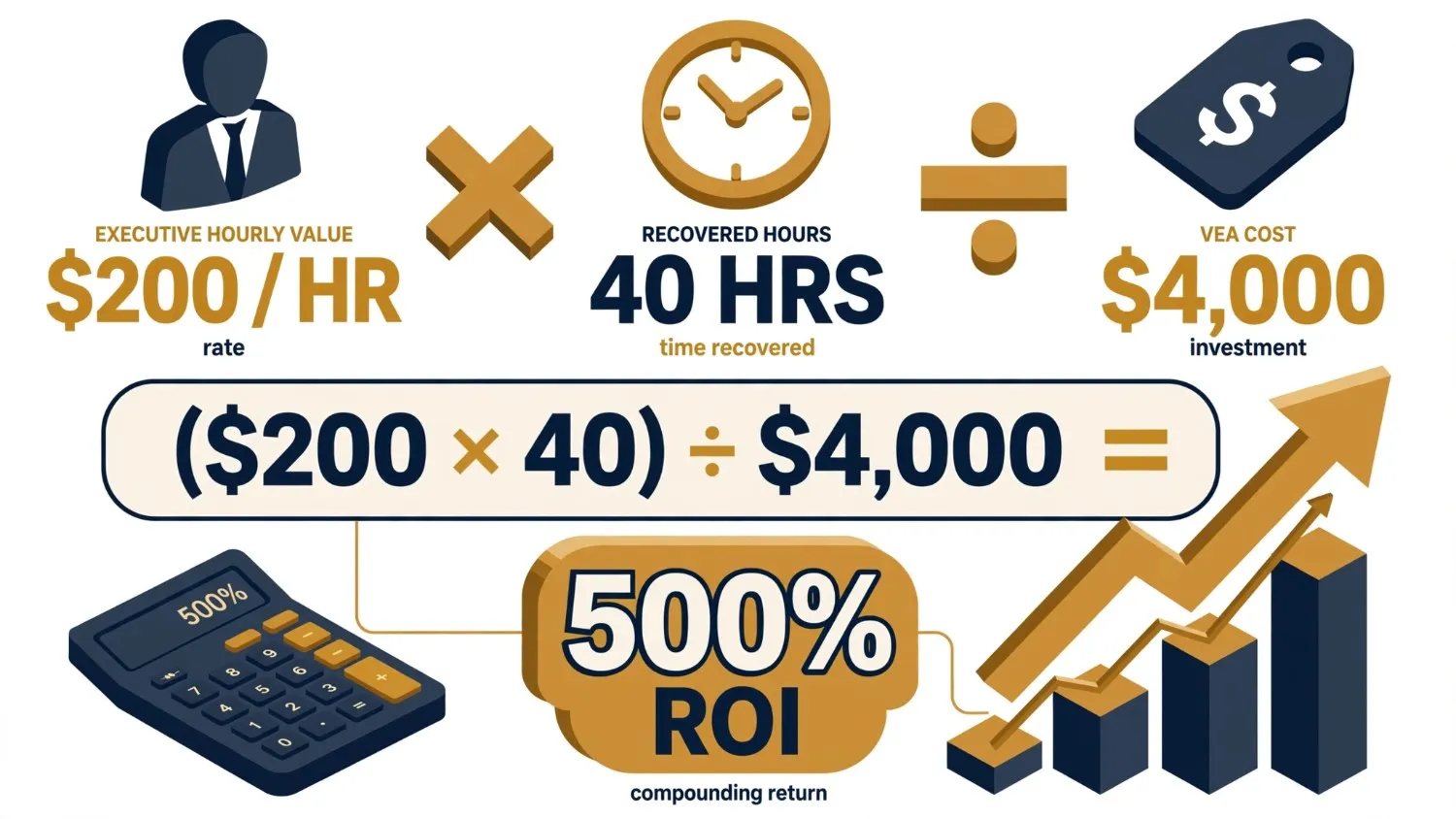
Step-by-step ROI calculation:
Establish your effective hourly value.
If your company generates $2 million annually and you work 50 hours per week, your effective output rate is approximately $769 per hour. Use whichever calculation method reflects your actual economic contribution.
Quantify delegatable hours per week.
Based on a personal time audit, identify the hours per week you currently spend on tasks a skilled VEA could handle: inbox management, calendar coordination, travel, meeting prep, research, and project follow-up. Most C-suite executives identify 15 to 25 hours per week in this category.
Calculate weekly recovered value.
Multiply your effective hourly rate by the recovered hours. At $300/hour and 18 hours recovered per week, that represents $5,400 in recovered executive capacity per week – or approximately $21,600 per month.
Compare against monthly VEA cost.
A full-time VEA engagement at $3,500 per month delivers $21,600 in recovered executive capacity against a $3,500 investment. The ROI in this scenario exceeds 500%.
Account for the ramp-up adjustment.
Apply a 40% to 60% efficiency discount to the first 60 days and model the full-year ROI accordingly. Even with the ramp-up cost included, the annual ROI at these assumptions remains compelling.
According to McKinsey Global Institute research on knowledge worker productivity, knowledge workers spend an average of 28% of their workweek managing email alone. For a 50-hour executive workweek, that represents 14 hours per week with clear delegation potential – just from inbox management. The VEA ROI case does not require exotic assumptions. It requires honest accounting of where executive time actually goes.
Frequently Asked Questions About Virtual Executive Assistant Cost
What is the average virtual executive assistant cost per month in 2026?
The average monthly virtual executive assistant cost varies significantly by model and geography. Through managed service providers, full-time support typically runs $1,500 to $4,500 per month. Through specialist agencies, dedicated C-suite support ranges from $2,500 to $6,000 per month. Direct freelance hires cost $800 to $11,200 per month depending on the VEA’s geography and hourly rate. The most common entry point for scaling executives is $2,000 to $3,500 per month through a managed or agency model.
Is virtual executive assistant cost lower than hiring in-house?
Yes: consistently and significantly. The fully loaded annual cost of a US-based in-house executive assistant typically ranges from $103,000 to $175,000 once salary, payroll taxes, benefits, equipment, office space, and recruitment costs are included. A comparable virtual executive assistant engagement through a managed service provider typically runs $18,000 to $54,000 annually – representing savings of $49,000 to $120,000 per year depending on scope and geography.
What factors affect virtual executive assistant pricing the most?
The five largest pricing variables are: geography (US vs. LATAM vs. Southeast Asia), experience tier (years of direct C-suite support), hiring model (direct freelance vs. agency vs. managed service), engagement structure (hourly vs. part-time retainer vs. full-time retainer), and scope complexity (basic administrative support vs. strategic executive partnership including board correspondence and multi-stakeholder coordination).
Are there hidden costs I should budget for beyond the hourly rate?
Yes. The four most commonly overlooked cost components are: executive management time (3 to 8 hours per month at your opportunity cost rate), onboarding and ramp-up investment (elevated cost during the first 60 days of any engagement), tool and software access provisioning ($50 to $300 per month depending on your stack), and replacement cycle cost if the engagement does not work out (1.5 to 3 months of equivalent rate in lost time and re-onboarding investment for direct freelance hires). Budget 20% to 30% above the nominal invoice rate to arrive at a realistic all-in monthly figure.
Is a more expensive VEA always better value?
Not automatically – but at the C-suite level, the relationship between experience tier and value delivered is strong. The most common cost error executives make is applying an entry-level rate to executive-level scope requirements. When the scope demands genuine judgment, discretion, and the ability to represent the executive in external communications, the investment in a senior-tier VEA consistently delivers better returns than the apparent savings of a lower-rate engagement that requires extensive oversight and correction.
How quickly can I expect to see ROI from a virtual executive assistant?
Most well-structured VEA engagements reach full productive velocity within 30 to 60 days. The ROI inflection point – where recovered executive capacity exceeds the combined direct and management overhead cost – typically arrives at 45 to 90 days for executives who invest in proper onboarding. Beyond the 90-day mark, a high-performing VEA engagement produces compounding returns as institutional knowledge deepens and proactive support capability expands.
Can I start with a part-time virtual executive assistant and scale up?
Yes – and for most executives, this is the recommended approach. Starting with a committed part-time retainer of 40 to 80 hours per month allows you to validate the working relationship, build the contextual foundation, and identify the full scope of delegation before committing to a full-time engagement. Most managed service providers and agencies accommodate scope expansion within an existing relationship without requiring a new matching or onboarding cycle. The key is to define a clear 30 to 60 day expansion trigger: a specific workload milestone or delegation threshold at which you will formalize the move to full-time support.
What to Ask Before Committing to Any Pricing Arrangement
Before you sign a contract or begin a paid trial, these are the questions that protect your investment and ensure the pricing structure actually matches your operational reality.
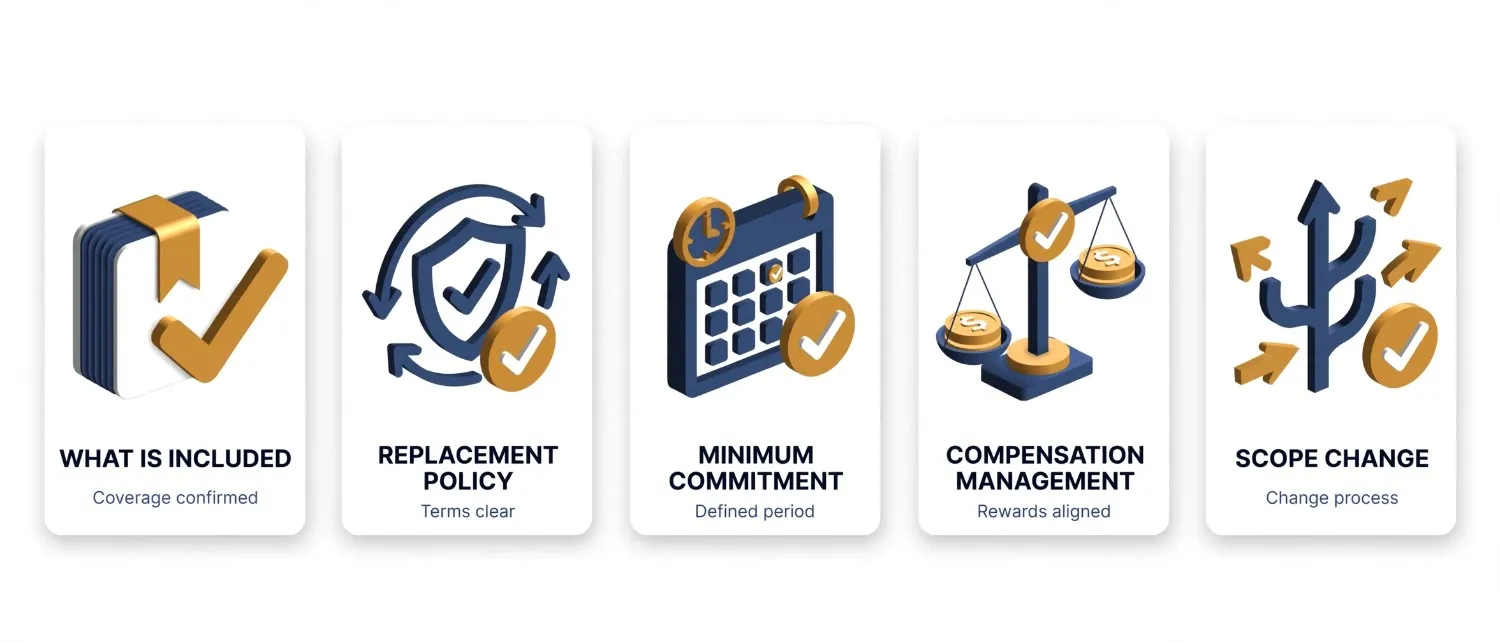
1. What is included in the quoted rate?
Clarify whether tools, software licenses, backup coverage, and management support are included in the monthly fee or billed separately. Some providers quote an attractive base rate that expands significantly once tool access and account management fees are added.
2. What is the replacement policy if the engagement does not work?
For agency and managed service providers, ask specifically: Is there a replacement guarantee? How many replacements are covered? What is the minimum performance period before replacement eligibility applies? What happens to onboarding investment if a replacement is needed?
3. What is the minimum commitment period?
Many providers require a 3 to 6 month minimum commitment. Understand whether this aligns with your risk tolerance and budget horizon before committing. Providers who offer shorter minimums with clear expansion paths are generally lower risk for executives evaluating the model for the first time.
4. How is the VEA compensated and managed?
For managed service models, confirm whether the provider employs the VEA directly and handles all HR, tax, and benefits obligations – or whether the service is structured as a pass-through arrangement that still creates contractor management obligations on your side.
5. What happens if scope needs change mid-engagement?
Confirm the mechanism for adjusting hours, scope, or support level as your needs evolve. Providers with rigid structures that require a full contract renegotiation to adjust scope will create friction at exactly the moments when you need operational flexibility most.
Pricing the Investment That Prices Everything Else
The virtual executive assistant cost question is ultimately not a procurement question. It is a strategic leverage question.
Every hour your executive time goes to work that a skilled VEA could handle is an hour not invested in growth, strategy, relationships, and the decisions that only you can make. Pricing that trade-off accurately requires going beyond the invoice rate to the full picture: the model you choose, the geography that fits your workflow, the scope that matches your actual needs, and the hidden costs that determine whether the engagement delivers on its potential.

The numbers in this guide are consistent across the market in 2026: virtual executive assistant cost runs 30% to 70% below the fully loaded cost of an equivalent in-house hire, depending on model and geography. For executives who structure the engagement properly – with the right scope definition, the right hiring model, and the right onboarding investment – the ROI is not marginal. It is transformational.
If you are ready to move from pricing research to a concrete engagement built around your actual workflow, that is scoped, priced, and structured for the level of support your leadership demands.