
To hire a virtual executive assistant who performs at the C-suite level, executives must move beyond resume screening and apply a multi-stage competency assessment framework that evaluates asynchronous communication proficiency, executive-voice authoring capability, discretionary judgment under ambiguity, and stakeholder management fluency. The most common failure mode in this hire is treating a VEA search like a general administrative hire – applying the same screening logic used for entry-level roles to a position that demands strategic-layer operational intelligence. A rigorous, structured selection process – covering role scoping, skills testing, behavioral interviewing, and structured onboarding – is the only reliable pathway to identifying a virtual executive assistant who protects executive bandwidth rather than consuming it.
Most executives who struggle with this hire do not struggle because great candidates don’t exist. They struggle because the process they use was never designed to find them.
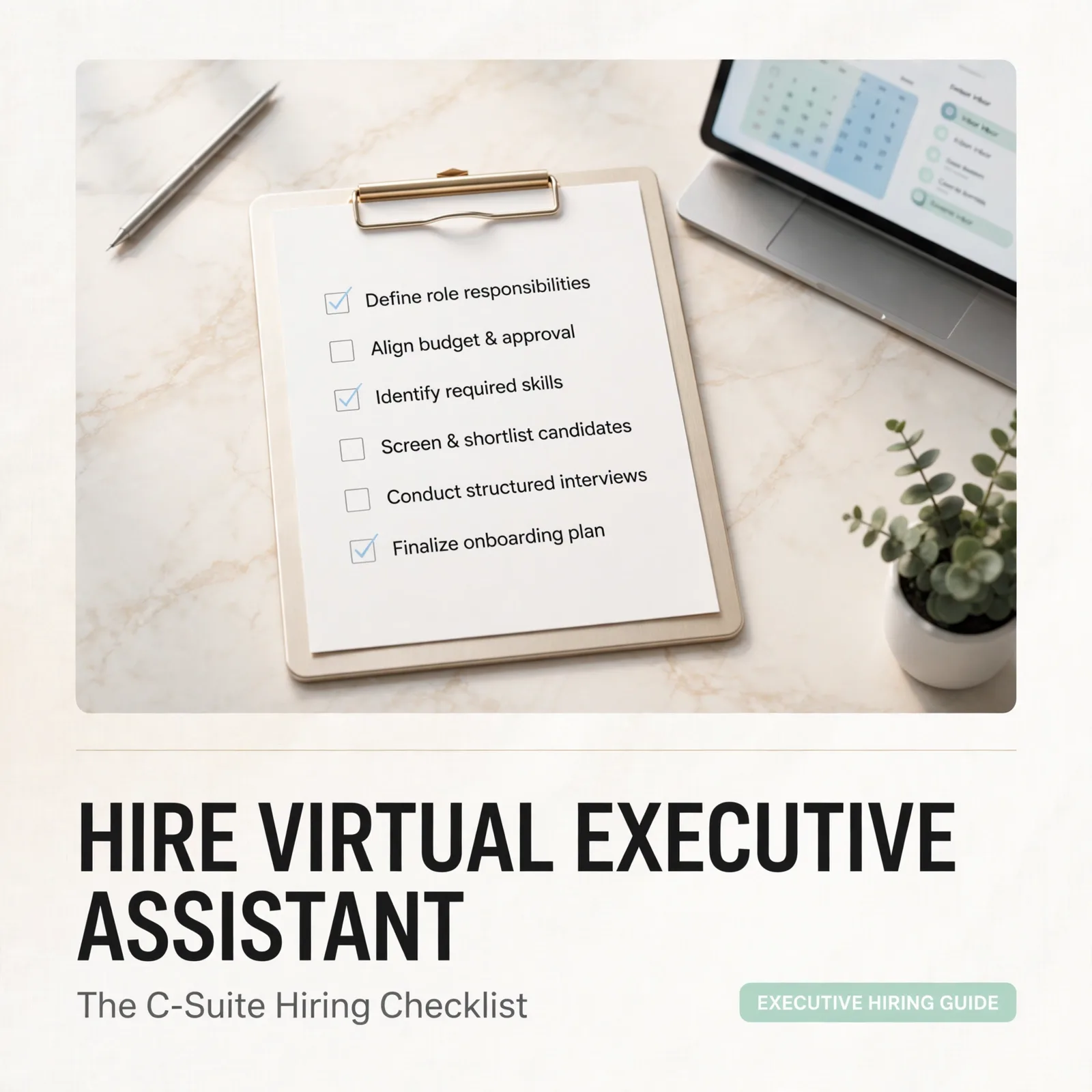
This guide gives you the exact checklist that experienced C-suite leaders use when making this hire: from defining the role correctly before you post a single job listing, through the final onboarding steps that determine long-term performance.
Organizations that invest in purpose-built virtual executive assistant services eliminate the friction of self-directed hiring by pairing executives with pre-vetted, C-suite-ready professionals who are assessed against executive-level performance standards from day one.
Why Most Executives Hire the Wrong VEA (And How to Avoid It)
The single most common reason this hire fails has nothing to do with the candidate. It has everything to do with the process.
Most executives approach a VEA search the way they approach any administrative hire: post a job description, conduct a 45-minute interview, check references, and make an offer. That process works reasonably well for entry-level support roles. It is a poor match for the complexity, trust requirements, and operational depth that a C-suite VEA position demands.
The consequences of a mismatched hire include:
- Weeks or months of onboarding investment lost when the relationship doesn’t work
- Confidential business information exposed to someone whose discretion was never properly tested
- Executive time increasing rather than decreasing during the adjustment period
- Damaged relationships with key stakeholders who received substandard communications in the executive’s name
- A demoralized belief that “VEAs just don’t work at this level” – when in reality, the hiring process was the failure point
The checklist that follows corrects each of these risk factors systematically.
Phase 1: Role Definition – Before You Post a Single Job Listing
Step 1: Audit Your Own Time Before Writing the Job Description
The most effective VEA hire starts with an honest, quantitative analysis of where your time currently goes. Before you define what you want your VEA to do, you need to understand what you are actually doing.
Spend one full work week tracking every task you personally complete, categorized by type and time required. Most executives discover a consistent pattern:
- 40-50% of their week goes to tasks that do not require their expertise specifically
- 20-30% goes to communication management (email, Slack, meeting coordination)
- 10-20% goes to preparation and logistics work (travel, meeting prep, document formatting)
- Only 20-30% goes to high-leverage, executive-only activity: strategy, key decisions, relationship development, and leadership
This analysis produces the foundation of your VEA’s actual job scope. It also gives you a baseline for measuring ROI after the hire.
Step 2: Separate “Must Delegate Now” from “Future Scope”
Not everything you want to delegate should be handed over on day one. Effective role definition separates responsibilities into three tiers:
- Calendar Management
- Inbox Triage
- Meeting Preparation
- Travel Logistics
- Expense Tracking
- Executive Voice Drafting
- Stakeholder Liaison
- Project Coordination
- Research and Briefing
- CRM Management
- Board Communications
- Vendor Negotiation
- Senior Stakeholder Management
- Decision-Making Proxy
- Confidential Operations
Tier 1 – Core Immediate Scope (Day 1 responsibilities):
- Calendar management and scheduling coordination
- Inbox triage and routine correspondence
- Meeting preparation, agendas, and follow-through
- Travel logistics and itinerary management
- Expense tracking and reconciliation
Tier 2 – Expanded Scope (30-90 days, as trust is established):
- Drafting communications in the executive’s voice
- Stakeholder liaison and relationship management
- Project coordination and cross-team follow-up
- Research and executive briefing preparation
- CRM management and contact database maintenance
Tier 3 – Strategic Scope (90+ days, for high-trust relationships):
- Handling confidential board and investor communications
- Representing the executive in vendor or partner negotiations
- Managing relationships with senior stakeholders independently
- Acting as a decision-making proxy within defined authority limits
Defining these tiers upfront sets accurate expectations for candidates and prevents scope mismanagement during onboarding.
Step 3: Document Your Non-Negotiable Working Style Requirements
A VEA relationship fails more often because of working style misalignment than skills gaps. Before hiring, document clearly:
- Your preferred communication cadence (daily briefings, async check-ins, real-time availability windows)
- Your communication platform preferences (email only, Slack-first, or hybrid)
- Your response time expectations for urgent versus non-urgent items
- Your time zone and overlap requirements
- Your preferred level of autonomy versus check-in frequency for task execution
- Confidentiality expectations and NDA requirements
This documentation becomes part of the candidate brief sent to finalists, ensuring self-selection by candidates who are not a fit before interview rounds begin.
Phase 2: Sourcing – Where to Find C-Suite-Ready VEA Candidates
The Three Primary Hiring Models
Knowing where to hire virtual executive assistant candidates at the executive level is as important as knowing how to evaluate them. Each sourcing model carries distinct tradeoffs.
| Hiring Model | Best For | Vetting Responsibility | Typical Cost Range | Replacement Guarantee |
|---|---|---|---|---|
| Specialist EA Agency | Executives with complex needs and limited time | Agency handles vetting | $2,500-$6,000/month | Usually yes |
| Direct Freelance Platform | Cost-sensitive or early-stage operators | Executive handles vetting | $25-$60/hour | No |
| Referral Network | Executives who value proven trust signals | Shared between network and executive | Variable | No |
| Managed EA Service | Scaling businesses wanting ongoing support infrastructure | Provider handles vetting and management | $1,500-$4,500/month | Usually yes |
For executives operating at the C-suite level, specialist agencies and managed service providers carry a meaningful advantage: the vetting work – including skills testing, reference verification, and confidentiality screening – has already been completed by a team with hiring expertise in this specific role type.
According to LinkedIn’s Global Talent Trends research, 89% of bad hires are attributable to poor cultural and working-style fit rather than skills deficiencies – a finding that underscores why process rigor matters more than any individual screening step.
What “C-Suite Level” Experience Actually Means in a VEA Candidate
The label “executive assistant” appears in many job histories. Not all of it reflects C-suite exposure. When evaluating candidates, specifically look for:
- Direct support of a C-level, VP-level, or equivalent principal (not department managers or mid-level directors)
- Experience managing external communications on behalf of the executive, not just internal scheduling
- Demonstrated handling of sensitive financial, personnel, or legal information
- Tenure of 2+ years with a single executive (longevity signals trust and performance, not just employment history)
- Experience managing multi-stakeholder ecosystems: board members, investors, major clients, and media contacts
Phase 3: The Screening Checklist – How to Evaluate Candidates Rigorously
Screening Stage 1: Resume and Application Review
At this stage, you are filtering for minimum viable qualifications, not selecting a hire. Specific criteria:
Include if the candidate demonstrates:
- 5+ years of executive support experience with at least one C-suite principal
- Proficiency in the specific tools your stack uses (Google Workspace, Salesforce, Asana, Slack, etc.)
- Documented experience managing external stakeholder communications
- Clear tenure patterns showing 2+ year engagements (not a series of 3-6 month contracts)
- Evidence of having expanded responsibility over time within roles (not static task execution)
Remove from consideration if:
- Resume shows only internal support roles without external communication responsibility
- Longest single engagement was less than 12 months without a clear reason
- No mention of specific tools used (suggests lack of operational depth)
- Application email or cover letter contains grammatical errors, informal tone, or generic content (this is their first communication in your voice – treat it as a live sample)
Screening Stage 2: The Written Assessment
Before conducting any interview, send qualified candidates a written assessment. This is the single most predictive tool in the VEA hiring process, and most executives skip it entirely.
The written assessment should include 4 components:
SCENARIO
RESOLUTION
Component 1: Inbox Triage Scenario Provide 12-15 fictional emails of varying urgency and sender importance. Ask the candidate to: categorize each email by priority tier, indicate which require executive attention versus autonomous handling, and draft brief responses to 3 of them in a professional executive tone.
Evaluate for: judgment accuracy, tone calibration, and response quality.
Component 2: Calendar Conflict Resolution Present a complex scheduling scenario with overlapping meetings, conflicting time zone requirements, and a VIP stakeholder who needs urgent access. Ask the candidate to resolve the conflict and explain their decision rationale.
Evaluate for: diplomatic communication skill, problem-solving logic, and prioritization framework.
DOCUMENT
SCENARIO
Component 3: Executive Briefing Preparation Provide a fictional context (company name, industry, and upcoming meeting with a prospective investor) and ask the candidate to prepare a 1-page briefing document using the information provided.
Evaluate for: synthesis capability, document quality, formatting, and completeness.
Component 4: Confidentiality Scenario Describe a situation where the candidate receives a request from a senior team member for information about an executive’s schedule or communication that has not been authorized for sharing. Ask them to respond in writing.
Evaluate for: discretion, professional boundary-setting, and communication grace under pressure.
Screening Stage 3: The Behavioral Interview
The behavioral interview for a C-suite VEA candidate should focus exclusively on demonstrated past behavior – not hypothetical responses. The fundamental principle is simple: past behavior in analogous situations is the strongest predictor of future performance.
The 12 most revealing behavioral interview questions for a VEA candidate:
- “Walk me through the most complex stakeholder communication you’ve managed independently on behalf of an executive. What was the situation, what did you decide, and what was the outcome?”
- “Describe a time when your executive’s priorities shifted dramatically mid-week. How did you restructure their schedule, and how did you communicate changes to affected parties?”
- “Tell me about a time you caught an error – in a document, a meeting booking, or a communication – before it reached your executive. How did you identify it and what did you do?”
- “Give me a specific example of a time you handled confidential information. How did you manage access, storage, and communication around it?”
- “Describe the most complex travel itinerary you’ve built. What contingency planning did you include, and did anything go wrong? If so, how did you handle it in real time?”
- “Tell me about a time you disagreed with a decision your executive made about a communication or scheduling priority. Did you push back? If so, how?”
- “Walk me through your process for managing an executive’s inbox. What system do you use, and how do you handle messages that require judgment calls about urgency?”
- “Describe a situation where you had to say no to someone – on behalf of your executive – in a way that preserved the relationship. How did you approach it?”
- “Tell me about a time you worked across multiple time zones to coordinate a high-stakes meeting. What challenges came up and how did you resolve them?”
- “Give an example of a report, deck, or briefing document you prepared that your executive used in a high-stakes meeting. What went into it and how was it received?”
- “Describe a time when you had to make a decision in your executive’s absence without being able to reach them. What did you decide and how did it turn out?”
- “Tell me about the most difficult executive you’ve supported. What made the relationship challenging and what did you do to make it work?”
What strong answers look like:
- Specific, detailed, and first-person (not “we” answers that obscure individual contribution)
- Demonstrate proactive rather than reactive thinking
- Show evidence of having thought through consequences, not just completed tasks
- Reflect genuine ownership of outcomes, including mistakes and lessons learned
What weak answers look like:
- Generic or theoretical (“I would always try to…”)
- Heavy reliance on team language that obscures individual accountability
- Inability to provide specific examples despite claimed experience
- Answers focused on tasks completed rather than judgment exercised
Screening Stage 4: Reference Verification
Reference checks for a C-suite VEA must go beyond standard employment verification. Specifically, contact the executive or principal the candidate supported directly – not HR or a former colleague.
The 5 reference questions that reveal the most:
- “Would you hire this person again to support you at the C-suite level? Why or why not?”
- “How did they handle your most sensitive communications and confidential information?”
- “Can you describe a time they handled a high-pressure situation independently and effectively?”
- “What is the area where they need the most growth or coaching?”
- “How did they communicate with you when something went wrong or when they needed a decision?”
The fourth question – asking for a genuine developmental area – is the most revealing. A reference who cannot name a single area for improvement is either being overly diplomatic or has not worked closely enough with the candidate to provide meaningful insight.
Phase 4: The Paid Trial Assignment
Why a Paid Trial Is Non-Negotiable
Interviews predict communication style. Written assessments test skills under controlled conditions. Only a paid trial assignment tests performance under real-world operational conditions – with genuine ambiguity, time pressure, and the complexity of actual executive support workflows.
Research from the Harvard Business Review on hiring decision quality demonstrates that work-sample tests are among the highest-validity predictors of on-the-job performance available in a hiring process, outperforming structured interviews, reference checks, and personality assessments.
Structuring the Paid Trial Effectively
The paid trial for a VEA position should run 3 to 5 business days and cover the core functions of the role with real task complexity. Compensate the candidate fairly – typically at their stated rate for the hours worked.
A well-designed paid trial includes:
- Day 1-2: Calendar management tasks using a real or simulated calendar with conflicts to resolve, a week of meetings to schedule, and timezone coordination across 3+ locations
- Day 2-3: Inbox management simulation with a representative sample of real-world email types – including a VIP sender requiring careful handling, several requests requiring judgment calls, and routine items requiring autonomous responses
- Day 3-4: A research and briefing assignment requiring synthesis of information from multiple sources into an executive-ready document
- Day 4-5: A communications task requiring the candidate to draft 4-5 professional emails on behalf of the executive, in a tone consistent with the briefing they were given
What to evaluate throughout:
- Initiative: Did they flag ambiguities proactively, or wait for direction?
- Communication quality: Were their updates clear, concise, and appropriately timed?
- Error rate: How many times did they produce output requiring correction?
- Time management: Did they complete tasks within reasonable timeframes without requiring hand-holding?
- Judgment: In the absence of explicit instructions, did their decisions reflect sound executive-level thinking?
The Complete Hire Virtual Executive Assistant Checklist
Use this master checklist as your end-to-end hiring protocol:
Pre-Hiring Preparation
- Complete a 1-week personal time audit to quantify delegatable work
- Define Tier 1, 2, and 3 scope with timelines
- Document working style, communication cadence, and non-negotiable requirements
- Identify the tools the VEA must be proficient in from day one
- Draft an NDA template for candidate-stage confidentiality protection
Sourcing and Application Review
- Choose your sourcing model (agency, direct, or referral) based on your capacity to vet
- Screen resumes for 5+ years of C-suite direct support experience
- Filter for 2+ year tenure patterns with individual principals
- Verify external stakeholder communication experience
- Eliminate applications with substandard written communication quality
Skills Assessment
- Send written assessment to qualified finalists
- Score inbox triage scenario for judgment and tone
- Score calendar conflict resolution for diplomacy and logic
- Score executive briefing document for quality and completeness
- Score confidentiality scenario for discretion and professional boundary management
Behavioral Interview
- Conduct 60-90 minute behavioral interview with all 12 questions above
- Use a standardized scoring rubric (1-5 on specificity, initiative, judgment, and communication quality)
- Include a second interviewer where possible for evaluation consistency
- Note: flag any candidate who cannot provide specific examples for multiple questions
Reference Verification
- Contact the most recent direct executive or principal the candidate supported
- Ask all 5 reference questions listed above
- Record verbatim responses to “What area needs the most growth?” question
- Verify at least one reference independently rather than using contacts provided solely by the candidate
Paid Trial Assignment
- Brief the candidate on your actual executive context, tools, and communication preferences
- Assign a 3-5 day structured trial covering all core function areas
- Compensate at the candidate’s stated hourly rate
- Evaluate against the 5 criteria: initiative, communication quality, error rate, time management, and judgment
- Debrief with candidate after the trial to assess self-awareness and coachability
Offer and Onboarding
- Execute NDA and contractor or employment agreement before access is granted
- Provide system access: calendar, inbox, CRM, project management tools, and travel platforms
- Complete a “brain download” session covering preferences, key contacts, and SOPs
- Schedule a daily 10-minute alignment call for the first 30 days
- Set 30, 60, and 90-day performance check-ins
Common Hiring Mistakes That Derail Even Experienced Executives
Mistake 1: Writing a Job Description Based on Tasks, Not Outcomes
Job descriptions that list tasks (“manage calendar, book travel, handle email”) attract task-execution candidates rather than strategic operators. Rewrite your job description around outcomes: “Protect 15-20 hours of executive time per week by owning all calendar, inbox, and logistical coordination without requiring executive oversight.”
This shift attracts candidates who think in terms of impact, not activity.
Mistake 2: Skipping the Written Assessment Because “It Slows Down the Process”
The written assessment is the highest-signal step in the process. Skipping it in the name of speed is the single most common predictor of a poor hire at the executive level. The additional 48 to 72 hours it adds to your timeline is a minor cost against the months of investment a bad hire consumes.
Mistake 3: Interviewing for Skills You Can Test
Do not spend interview time asking candidates if they are proficient in Google Workspace, Salesforce, or Asana. Test it in the written assessment and paid trial. Reserve interview time for evaluating judgment, discretion, communication instinct, and executive partnership fit – qualities you cannot assess through a skills task.
Mistake 4: Using Only Candidate-Provided References
Candidates naturally provide references who will speak well of them. Supplement candidate-provided references with independent contact attempts where possible – for example, reaching out directly to the organization the candidate listed rather than exclusively through the personal contact they named.
Mistake 5: Treating the Paid Trial as Optional for Strong Candidates
The temptation to skip the paid trial for candidates with impressive credentials is understandable – and dangerous. A polished resume and a strong interview identify communication ability. They do not identify operational reality. A candidate who struggles to complete a well-scoped 3-day paid trial effectively would have struggled in the role itself, regardless of how compelling they appeared on paper.
Mistake 6: Delaying Full System Access After the Offer
Executives who grant partial access during onboarding – giving calendar access but not inbox, or inbox access but not CRM – create artificial constraints that prevent the VEA from building the contextual intelligence needed to work proactively. Grant full system access from day one of the confirmed engagement, after the NDA and agreement are executed.
Expert Tips From Executives Who Got This Hire Right
Experienced operators who have built high-performing VEA relationships share consistent patterns in how they approached the hire and the early relationship.
Invest 3 hours in a “principal brief” document before Day 1. Write down everything a high-performing VEA would need to know to represent you well: your communication style, your most important relationships and their context, your recurring commitments, your preferences for specific meeting types, your decision-making authority thresholds, and your pet peeves. The ROI of this document compounds every week for as long as the relationship continues.
Define one clear success metric for the first 30 days. Rather than expecting broad performance across all dimensions immediately, identify the single most impactful thing your VEA can improve in the first month – typically inbox management or calendar efficiency – and measure specifically against that metric. This creates early wins, builds trust, and gives the VEA a clear north star for prioritization.
Establish communication protocol before the relationship starts. Decide explicitly: How will the VEA reach you if something urgent arises? What constitutes “urgent”? What is the response time expectation for non-urgent items? What is the preferred channel for questions versus updates? These decisions, made upfront, prevent the vast majority of early-relationship friction.
Give feedback in writing during the first 90 days. Verbal feedback is ephemeral in remote relationships. Written feedback – delivered promptly after you observe something that needs adjustment – creates a reference document the VEA can return to, reduces the risk of miscommunication, and establishes a performance culture from the start.
According to research on remote work effectiveness from Stanford University’s Institute for Economic Policy Research, remote workers who receive structured, documented performance feedback in the first 90 days of an engagement show significantly higher long-term performance and retention rates than those who receive only informal guidance.
How to Structure the First 90 Days After You Hire a Virtual Executive Assistant
SETTING
- System access and tool setup.
- Brain download working session.
- Morning check-in protocol established.
- 3-5 core recurring tasks delegated.
ACTIVATION
- Progressive inbox management handover.
- Response templates co-created.
- First 30-day performance check-in.
- Calendar ownership expanded to external scheduling.
Days 1-7: Foundation Setting
- Complete system access setup across all platforms
- Conduct a 2-3 hour “brain download” working session
- Establish the daily morning check-in protocol
- Identify 3-5 recurring tasks for immediate full delegation
- Set the 30-day success metric
Days 8-30: Core Function Activation
- Transition inbox management progressively from shared access to autonomous management
- Establish response templates together for the 10 most common email types
- Complete the first 30-day check-in; gather mutual feedback
- Identify any skill gaps and address them with resources, training, or scope adjustment
- Expand calendar ownership to include external stakeholder meeting scheduling
EXPANSION
- Travel coordination fully autonomous.
- Executive briefing documents for all meetings.
- Communications drafting with approved external emails.
- 60-day check-in and Tier 2 scope assessment.
PARTNERSHIP
- Full Tier 2 scope activated.
- CRM and project coordination expanded.
- Formal 90-day review with scope roadmap.
- Months 4-12 delegation plan defined.
Days 31-60: Trust and Scope Expansion
- Transition travel coordination to fully autonomous VEA ownership
- Begin stakeholder briefing document preparation for all incoming meetings
- Test communications drafting with 3-5 approved external emails sent in your name
- Complete the 60-day check-in; discuss Tier 2 scope readiness
- Evaluate judgment quality in the decisions made during the first 60 days
Days 61-90: Strategic Partnership Development
- Expand to full Tier 2 scope if performance warrants
- Discuss longer-term delegation roadmap including CRM management and project coordination
- Complete the 90-day check-in with formal scope and compensation review if applicable
- Identify the highest-leverage areas for continued scope expansion in months 4-12
Hiring Models Compared: Agency vs. Direct Hire vs. Managed Service
| Factor | Direct Freelance Hire | Specialist Agency | Managed EA Service |
|---|---|---|---|
| Upfront time investment | High (executive does full vetting) | Low (agency pre-vets) | Very Low (provider manages) |
| Vetting rigor | Dependent on executive’s process | High (agency standards) | High (provider standards) |
| Replacement if poor fit | Executive restarts process | Agency provides replacement | Provider replaces quickly |
| Cost | Lowest | Moderate-High | Moderate-High |
| Ongoing management support | None | Limited | Included |
| Speed to productive engagement | Slowest | Fast | Fastest |
| Best for | Cost-sensitive, time-rich executives | Executives with specific requirements | Scaling leaders with limited hiring bandwidth |
For executives who cannot afford – in time or risk – to absorb a poor hire, agency and managed service models offer a meaningful structural advantage. The vetting infrastructure that exists within a quality provider is difficult to replicate in a single hiring process, particularly for executives without prior experience hiring for this specific role.
Frequently Asked Questions About How to Hire a Virtual Executive Assistant
What is the most important step when you hire a virtual executive assistant at the C-suite level?
The written assessment is the single most predictive step. Most executives skip it, relying on resumes and interviews – both of which primarily measure communication style rather than actual operational capability. A structured written assessment covering inbox triage, calendar conflict resolution, briefing document preparation, and a confidentiality scenario reveals the judgment quality and execution skills that define C-suite-level VEA performance.
How long does it typically take to hire a virtual executive assistant?
A rigorous process typically takes 3 to 5 weeks from role definition to paid trial completion. This includes 1 week for role definition and job posting, 1 to 2 weeks for application review and written assessment, 1 week for behavioral interviews and reference checks, and 1 week for the paid trial assignment. Executives who compress this timeline by skipping assessment stages consistently report higher rates of poor-fit outcomes.
Should I hire a virtual executive assistant through an agency or directly?
The right model depends on your time availability for vetting, your risk tolerance for a poor hire, and your need for ongoing management support. Direct hiring offers the lowest cost and highest control but requires significant time investment in vetting. Agency and managed service models cost more but dramatically reduce the executive’s time investment and provide replacement guarantees that protect the ROI of the engagement.
What is a fair hourly rate when I hire a virtual executive assistant at the executive level?
C-suite-level virtual executive assistant rates vary meaningfully by geography and experience. US-based VEAs with direct C-suite experience typically range from $35 to $75 per hour. Through agency or managed service providers, monthly retainer rates run from approximately $2,500 to $6,000 depending on scope and hours. These figures compare favorably against the fully-loaded annual cost of an in-office EA, which typically runs $90,000 to $130,000 when benefits, office overhead, and management costs are included.
How do I know if a VEA candidate is actually C-suite-ready versus just claiming to be?
C-suite readiness is demonstrated, not claimed. The written assessment and paid trial will reveal it within days. Specifically, look for: the ability to handle ambiguous instructions without excessive clarification requests; communication output that is board-quality in tone and accuracy; proactive identification of issues the executive hasn’t flagged yet; and a discretion instinct that surfaces consistently in how they handle sensitive information across all assessment stages.
What happens if the relationship isn’t working after onboarding?
Address performance concerns formally and in writing at the 30-day checkpoint rather than waiting for a crisis. Most underperformance in the first 90 days is attributable to scope misalignment, inadequate onboarding, or missing context – not to fundamental capability gaps. A structured conversation identifying specific gaps, with a 30-day improvement plan, resolves the majority of early-stage performance issues. If performance does not improve after a structured improvement period, the paid trial data and assessment results provide a clear, fair basis for ending the engagement.
Can I hire a virtual executive assistant part-time at the C-suite level?
Yes – and for many executives, a part-time engagement of 15 to 20 hours per week is the optimal starting point. It allows you to validate the relationship at lower cost, build trust progressively, and expand scope as the VEA’s contextual intelligence deepens. The key is to define the part-time scope carefully: avoid fragmenting high-judgment tasks across only a few hours per week, as this prevents the VEA from building the continuous situational awareness needed for proactive performance.
The Hire That Changes How You Lead
The decision to hire a virtual executive assistant at the C-suite level is not a staffing decision. It is a strategic infrastructure decision that determines how much of your own capacity you can direct toward the work that only you can do.
Every executive who has made this hire well – with a rigorous process, a realistic scope definition, and a structured onboarding investment – reports the same experience: they cannot imagine operating without it.
The process outlined in this checklist does not guarantee a perfect hire. No hiring process does. What it does guarantee is that you will make the decision with the highest-quality information available, eliminate the most common failure modes, and build a foundation for a high-performance executive partnership from day one.
If you are ready to stop running a self-directed search and work with a provider who has already done the vetting work for you, who is built for the demands of C-suite support from the moment they start.
Contact today for hiring a Pre-Qualified Virtual Executive Assistant →