
A virtual executive assistant (VEA) is a remote, senior-level professional who delivers C-suite administrative and operational support through asynchronous and synchronous digital workflows – managing calendar architecture, inbox triage, stakeholder communications, travel logistics, and project coordination without requiring physical co-location. Unlike generalist virtual assistants, a VEA operates at the strategic layer of an executive’s workflow, functioning as a proactive decision-support partner rather than a task executor. The standard virtual executive assistant job description dramatically undersells this role: what a skilled VEA actually does, day-to-day, is protect an executive’s cognitive bandwidth so that every hour is directed toward high-leverage decisions.
If you’ve read a typical job posting for this role, you’ve likely seen bullet points like “manage calendars” and “book travel.” Those tasks are real – but they only scratch the surface. The actual daily work of a virtual executive assistant is far more dynamic, strategic, and mission-critical than any standard description captures.
Whether you’re a founder considering your first hire, a scaling CEO trying to protect your time, or an executive evaluating remote support models, this guide breaks down what a VEA truly does – hour by hour, task by task, and impact by impact.
Businesses that invest in professional virtual executive assistant services typically recover 15 to 25 hours of leadership time per week, channeling those recaptured hours directly into revenue-generating and growth-focused activities.

What the Job Description Says vs. What the Job Actually Requires
The gap between a formal job description and the lived reality of the role is significant. Most job postings are written by HR teams referencing outdated templates. They capture the administrative skeleton of the role but miss the operational intelligence, emotional intelligence, and strategic judgment that distinguish an exceptional VEA.
Here is a direct comparison:
| What the Job Description Says | What the Role Actually Requires |
|---|---|
| “Manage executive calendar” | Architect the executive’s week around strategic priorities, protect focus blocks, and diplomatically decline or reschedule low-ROI meetings |
| “Handle correspondence” | Triage 200+ emails daily, draft high-stakes responses, filter noise, and escalate only what requires the executive’s direct attention |
| “Coordinate travel” | Build multi-leg, multi-timezone itineraries with contingency plans, preferred vendor relationships, and real-time adjustment protocols |
| “Prepare reports and presentations” | Synthesize data from multiple sources into board-ready decks, briefing documents, and executive summaries with zero margin for error |
| “Support project management” | Track cross-functional deliverables, maintain accountability systems, and ensure stakeholders meet deadlines without executive micromanagement |
| “Maintain confidentiality” | Serve as the trusted custodian of sensitive business intelligence, personnel matters, and financial information at the C-suite level |
The table above reveals a consistent pattern: every “simple” task in a VEA’s job description actually contains layers of judgment, communication skill, and contextual intelligence that take time to develop and execute properly.
A Real Day in the Life: Hour-by-Hour Breakdown
Understanding the virtual executive assistant job description comes to life when you follow the actual workflow of a high-performing VEA through a single business day.
Morning: Priming the Executive for a High-Performance Day
A VEA’s morning starts before the executive even opens their laptop. By the time the CEO sits down, the VEA has already:
- Scanned and triaged the overnight inbox – flagging urgent items, archiving noise, and preparing draft responses for approval
- Reviewed the day’s calendar – confirming all meetings, attaching relevant briefing notes, and ensuring video conference links are functional
- Prepared a daily briefing document – summarizing the top three priorities, key decisions needed, and any time-sensitive external developments
- Sent morning confirmations – reaching out to all scheduled meeting participants to confirm attendance and circulate agendas
- Reviewed pending project dashboards – checking task management tools such as Asana, Monday.com, or ClickUp for overdue items or stalled deliverables
This pre-work alone represents 1 to 2 hours of skilled labor that directly determines the quality of the executive’s morning.
Midday: Real-Time Triage and Coordination
During core business hours, a VEA operates as the executive’s operational nerve center. Key midday responsibilities include:
- Live inbox management – processing emails in real time, responding to routine inquiries with approved templates, and flagging items requiring executive judgment
- Meeting follow-through – capturing action items during or immediately after calls, distributing meeting notes, and assigning follow-up tasks to relevant team members
- Stakeholder liaison – serving as the executive’s point of contact for internal teams, board members, investors, clients, and vendors
- Research and intelligence gathering – compiling competitive analysis, industry news summaries, background checks on prospective partners, or vendor comparisons
- Document preparation – drafting contracts, proposals, presentations, and internal memos for review and approval
Afternoon: Strategic Support and Forward Planning
The afternoon shifts toward planning and proactive support:
- Next-day and next-week calendar preparation – identifying scheduling conflicts, proposing agenda structures, and reaching out to arrange future meetings
- Project status tracking – checking in with cross-functional team leads, updating project trackers, and escalating blockers to the appropriate owner
- Vendor and partner coordination – managing relationships with service providers, processing invoices, and ensuring operational contracts remain current
- Personal administrative tasks – handling personal schedule requests, family commitments, or lifestyle logistics the executive has delegated
- Expense reporting and financial tracking – reconciling credit card statements, categorizing business expenses, and preparing summary reports for accounting
End of Day: Handoff and Transition
Before logging off, a high-performing VEA completes a clean handoff:
- End-of-day summary to the executive – noting what was completed, what is pending, and what requires a decision the following morning
- Preparing next morning’s briefing – drafting the next day’s priority list based on calendar, inbox, and project status data
- Urgent flag review – ensuring no critical items fell through the cracks during the day’s activity
The 8 Core Functions in a Virtual Executive Assistant Job Description
Let’s go deeper on each core function a VEA performs, with the real-world detail that standard job descriptions omit.
1. Calendar Architecture and Time Protection
A VEA does not simply “schedule meetings.” They actively design the executive’s time as a strategic asset. This means:
- Identifying and protecting deep-work blocks for high-priority projects
- Implementing “meeting-free mornings” or similar productivity frameworks
- Applying rules-based calendar management (for example: no back-to-back calls, buffer time before board meetings, dedicated prep windows before complex negotiations)
- Handling time zone complexity across global teams and international partners
- Proactively rescheduling low-priority commitments when high-value opportunities arise
According to Harvard Business Review research on executive time use, CEOs spend an average of 23% of their time in meetings they rate as unproductive. A skilled VEA is the first line of defense against this pattern.
2. Inbox Triage and Communication Management
For most executives, email represents the single largest source of cognitive drag. A VEA who manages this function well can reclaim 2 to 3 hours daily. The real work involves:
- Establishing and continuously refining an inbox triage system (using labels, filters, and priority flags)
- Drafting responses in the executive’s voice with brand-appropriate tone
- Managing VIP sender lists and ensuring key stakeholders receive prompt, professional replies
- Unsubscribing from irrelevant lists and reducing inbox noise over time
- Managing multiple email accounts and communication platforms, including Slack, Teams, and SMS
3. Travel Logistics and Itinerary Management
Business travel coordination goes far beyond booking flights. A VEA managing executive travel handles:
- Multi-leg domestic and international itineraries across multiple time zones
- Preferred airline, hotel, and ground transportation arrangements
- Visa and entry requirement research for international travel
- Packing lists, travel document preparation, and pre-travel briefings
- Real-time monitoring during travel for delays, cancellations, or gate changes
- Post-travel expense reconciliation and reimbursement processing
4. Meeting Preparation and Follow-Through
One of the most underappreciated aspects of the virtual executive assistant job description is meeting intelligence. Before any important meeting, a VEA prepares:
- Briefing documents with background on attendees, company context, and discussion points
- Relevant financial data, project updates, or competitive intelligence
- Presentation decks reviewed for accuracy and formatting
- Pre-meeting agendas distributed to all participants
After the meeting, they:
- Transcribe or summarize key decisions and action items
- Assign follow-up tasks with owners and deadlines in the project management system
- Send follow-up communications to external participants
- Update the CRM system with notes on client or partner conversations
5. Project and Operations Coordination
Many VEAs evolve into de facto project coordinators for their executives. This function includes:
- Tracking deliverables across multiple concurrent projects using tools such as Asana, Notion, or Monday.com
- Maintaining accountability systems and nudging team members who are behind schedule
- Preparing status update reports for the executive without requiring them to chase information
- Coordinating cross-departmental initiatives and ensuring handoffs between teams occur smoothly
- Managing vendor relationships and contract renewals on behalf of the executive
6. Research and Intelligence Synthesis
Executives make better decisions when they have curated, accurate information. A VEA’s research responsibilities include:
- Market and competitive research compiled into concise executive briefs
- Due diligence research on prospective hires, partners, or acquisition targets
- Industry news monitoring with daily or weekly summaries tailored to the executive’s interests
- Prospect and client background research before sales calls or investor meetings
- Travel destination research, venue sourcing, and event logistics research
7. Stakeholder and Relationship Management
A high-performing VEA becomes the executive’s relationship infrastructure. This means:
- Maintaining a CRM or contact database with notes on relationships, last contact, and follow-up reminders
- Sending timely follow-up messages on behalf of the executive after networking events
- Managing birthday, anniversary, and milestone acknowledgment for key contacts
- Drafting and sending personalized outreach to prospects, clients, and partners
- Acting as a gatekeeping layer that filters inbound requests and routes them appropriately
8. Confidential and Sensitive Information Management
Perhaps the most trust-dependent aspect of the role, this includes:
- Handling confidential board communications, personnel matters, and financial documents
- Managing access credentials and digital security protocols
- Processing sensitive personal information related to the executive’s personal and family life
- Maintaining non-disclosure agreement (NDA) compliance in all communications
- Exercising discretion across all digital platforms and communication channels
Virtual Executive Assistant vs. Virtual Assistant: Understanding the Difference
This distinction matters enormously when hiring. Many business owners bring on a standard VA expecting executive-level support – and end up disappointed.
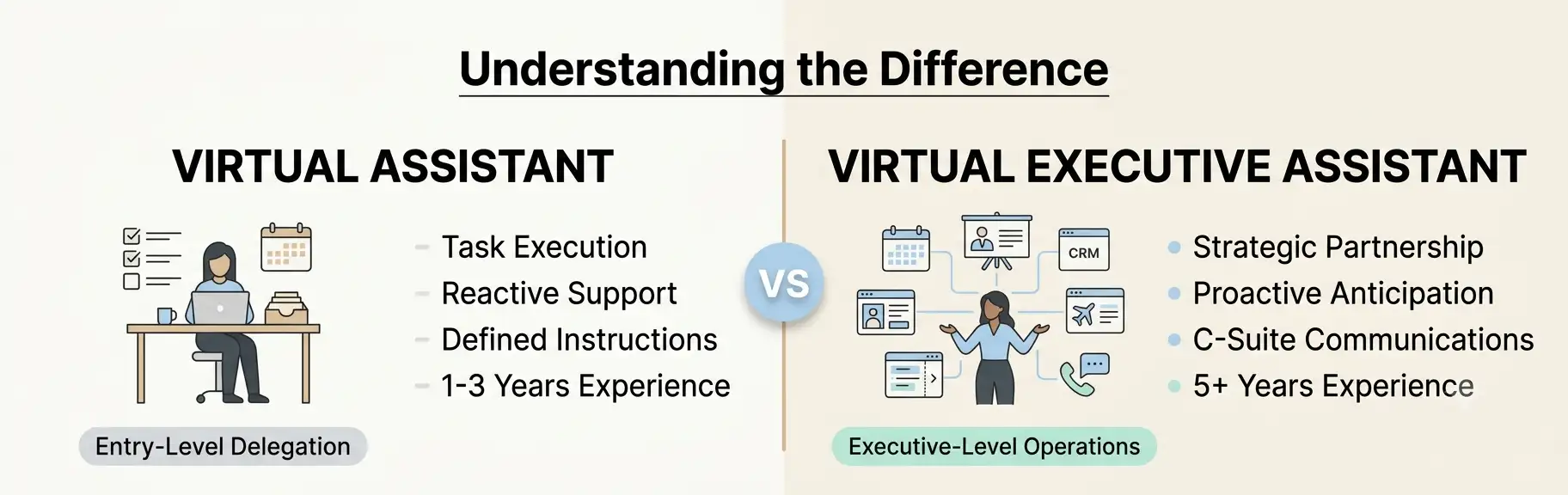
| Capability | Virtual Assistant (VA) | Virtual Executive Assistant (VEA) |
|---|---|---|
| Task complexity | Routine, clearly defined tasks | Complex, ambiguous, judgment-dependent tasks |
| Decision-making | Executes instructions | Anticipates needs and acts proactively |
| Communication level | Internal team support | C-suite, board, investor, and client communication |
| Calendar management | Basic scheduling | Strategic time architecture |
| Email handling | Sorting and forwarding | Drafting responses, inbox ownership |
| Project coordination | Single-task tracking | Multi-project, cross-functional oversight |
| Confidentiality level | Standard data handling | Highly sensitive executive-level discretion |
| Relationship management | Limited | Active stakeholder and CRM management |
| Experience level | 1-3 years | 5+ years in executive support roles |
| Hourly rate (US market) | $15 – $25/hr | $35 – $75/hr |
The right choice depends entirely on your support needs. If you need task execution, a general VA delivers solid ROI. If you need a trusted partner who can run complex, multi-stakeholder workflows without supervision, a virtual executive assistant is the correct investment.
The Skills That Define an Outstanding VEA
A job description lists skills as a checklist. In practice, the skills that separate excellent VEAs from average ones are more nuanced.
Technical Proficiency
- Google Workspace and Microsoft 365 – advanced mastery, not basic familiarity
- Project management platforms – Asana, Monday.com, ClickUp, Notion, or Basecamp
- CRM systems – Salesforce, HubSpot, or similar platforms
- Communication tools – Slack, Microsoft Teams, Zoom, and enterprise messaging systems
- Expense management – Expensify, Concur, or QuickBooks
- Travel booking platforms – Egencia, Concur Travel, or direct vendor portals
Soft Skills and Judgment
- Proactive communication – surfacing issues before they become problems
- Executive voice development – writing in the executive’s tone so communications are indistinguishable from the principal
- Emotional intelligence – reading context, managing sensitive situations, and knowing when to escalate
- Discretion and confidentiality – handling sensitive information with absolute professional integrity
- Prioritization under pressure – making smart triage decisions when multiple urgent items arrive simultaneously
Common Mistakes Executives Make When Working with a VEA
Even when hiring the right person, many executives fail to fully leverage the relationship. Here are the most common errors:
Mistake 1: Treating a VEA Like a Task Ticket System
If you only send tasks when something is on fire, you miss 80% of the value. The best VEA relationships involve proactive briefing, shared context, and ongoing communication about priorities.
Mistake 2: Withholding Context
A VEA who doesn’t know your strategic priorities, your preferred communication style, or your key relationships cannot do their best work. Invest time upfront in comprehensive onboarding.
Mistake 3: Not Delegating Email Fully
Many executives give their VEA calendar access but keep their inbox locked. This creates a fragmented workflow. Full inbox delegation, with clear guidelines on tone and authority, unlocks exponentially more value.
Mistake 4: Micromanaging Output Quality
Trust is the foundation of an effective executive support relationship. Define outcomes, establish quality standards, and give your VEA the autonomy to execute. Micromanagement creates bottlenecks and erodes the VEA’s proactive initiative.
Mistake 5: Skipping the Onboarding Investment
A VEA needs 2 to 4 weeks to deeply understand your workflow, preferences, stakeholders, and operating rhythm. Executives who skip structured onboarding report slower-than-expected returns on the relationship.
How to Write an Accurate Virtual Executive Assistant Job Description
If you’re ready to hire, your job description should reflect the actual scope of the role. Here’s a framework:
Step 1: Define the Executive’s Pain Points First
Before listing tasks, articulate the problems you need solved. Are you drowning in email? Losing track of project commitments? Spending too much time on travel coordination? Start with outcomes, not activities.
Step 2: Separate “Must Do” from “Nice to Have”
Classify responsibilities into core functions (non-negotiable) and secondary functions (welcome but not essential). This clarifies expectations for candidates and helps filter for the right fit.
Step 3: Specify the Tools in Your Stack
List every platform the VEA will need to operate in from day one. This filters for candidates with relevant technical experience and sets clear expectations.
Step 4: Define the Communication Cadence
Specify how the VEA will communicate with you: daily briefing calls, asynchronous Slack check-ins, weekly video syncs, or a combination. Communication rhythm is one of the most overlooked elements in job descriptions.
Step 5: Be Explicit About Confidentiality Expectations
If the VEA will handle sensitive financial, personnel, or legal information, say so clearly. This filters for candidates with appropriate discretion and experience at the executive level.
Step 6: Include the Real Scope of Decision-Making Authority
Will the VEA be authorized to respond to emails on your behalf? Book travel independently? Make vendor decisions within a budget threshold? Define the decision rights upfront to avoid ambiguity once they are onboarded.
Expert Tips for Getting Maximum ROI from a Virtual Executive Assistant
Leading executives and operators share consistent advice on extracting maximum value from a VEA relationship. According to research on executive productivity from McKinsey, knowledge workers who operate with strong administrative support are significantly more likely to stay in strategic, high-value work.
5 EXPERT TIPS For Maximum ROI from Your Virtual Executive Assistant
BRAIN DOWNLOAD
Build a comprehensive reference guide covering preferences, SOPs, and key contacts in the first week
SYSTEM ACCESS
Grant full CRM, calendar, and inbox access on day one to accelerate contextual intelligence
RESPONSE TEMPLATES
Co-create 10-15 pre-approved email templates covering the most common correspondence types
DAILY ALIGNMENT
Implement a 10-minute morning sync call to eliminate asynchronous back-and-forth friction
90-DAY REVIEW
Schedule formal check-ins at 30, 60, and 90 days to refine scope and expand delegation
Here are the expert-level best practices:
Build a “brain download” document. Spend 2 to 3 hours in the first week creating a comprehensive reference guide covering your preferences, recurring contacts, communication style, and standard operating procedures. This single investment compounds in value over months and years.
Create pre-approved response templates. Work with your VEA to develop templated responses for the 10 to 15 most common email types you receive. Once approved, these let your VEA handle the majority of correspondence autonomously.
Implement a daily 10-minute alignment call. A brief synchronous check-in each morning dramatically reduces asynchronous back-and-forth and ensures the VEA is aligned on daily priorities.
Grant CRM and calendar access on day one. The earlier your VEA has full system access, the faster they can begin building the contextual intelligence needed to work proactively.
Review and refine the relationship at 30, 60, and 90 days. Schedule formal check-ins to adjust scope, refine communication protocols, and expand delegation as trust builds.
The ROI of a Virtual Executive Assistant: Making the Business Case
Many leaders hesitate to invest in VEA support because the cost feels abstract. Here is a concrete framework for calculating return on investment.
THE ROI OF A VIRTUAL EXECUTIVE ASSISTANT
Recovered executive time per week
Annual value of recovered capacity
Time Recovery Value
If your effective hourly rate as an executive is $200 per hour and a VEA recovers 15 hours of your time per week, that represents $3,000 in recovered executive capacity per week – or approximately $156,000 annually.
Compare that to the fully-loaded annual cost of a high-quality virtual executive assistant, typically $40,000 to $80,000 depending on scope and experience level, and the ROI case becomes compelling.
Quality-of-Decision Improvement
Time recovery is only part of the story. When executives operate with better briefing documents, cleaner inboxes, and well-prepared meetings, the quality of decisions improves. Fewer items fall through the cracks. Stakeholder relationships stay warm. Projects move forward.
These are difficult to quantify precisely, but experienced operators consistently cite decision quality as one of the most meaningful benefits of excellent executive support, second only to time recovery.
Burnout Prevention
Research from the American Psychological Association consistently identifies cognitive overload as a primary driver of executive burnout. A VEA who actively reduces cognitive load by managing complexity, information volume, and administrative burden acts as a structural burnout prevention tool.
Frequently Asked Questions About the Virtual Executive Assistant Job Description
What exactly is included in a virtual executive assistant job description?
A virtual executive assistant job description typically covers calendar management, inbox triage, travel coordination, meeting preparation, document drafting, project tracking, stakeholder communication, and confidential information management. However, the actual day-to-day scope expands significantly based on the executive’s industry, company stage, and personal preferences. Most high-performing VEAs also take on research, CRM management, and operational coordination well beyond the formal job description.
How is a virtual executive assistant different from a regular virtual assistant?
A virtual executive assistant operates at a higher level of complexity, judgment, and confidentiality than a general virtual assistant. They handle C-suite communications, complex multi-stakeholder coordination, and proactive strategic support. A regular VA typically executes clearly defined, repetitive tasks with limited independent decision-making. The virtual executive assistant job description demands executive-level discretion, communication polish, and the ability to anticipate needs rather than simply respond to instructions.
What qualifications should a virtual executive assistant have?
Most high-performing VEAs have 5 or more years of experience in executive support roles, either in-person or remote. Key qualifications include advanced proficiency in project management and communication tools, demonstrated experience managing C-suite communications, strong written communication skills, proven discretion with sensitive information, and the ability to work independently with minimal supervision.
How many hours per week does a virtual executive assistant typically work?
Engagement structures vary widely. Some executives hire a VEA on a part-time basis (15 to 20 hours per week) for targeted support. Others require full-time dedicated support (40+ hours per week). The right scope depends on the volume of administrative and operational work the executive currently handles personally. A useful benchmark: if an executive is spending more than 3 hours daily on tasks that do not require their expertise specifically, a full-time VEA is likely justified.
Can a virtual executive assistant handle confidential business information?
Yes. Managing confidential information at the C-suite level is a core component of the virtual executive assistant job description. Professional VEAs operate under non-disclosure agreements, maintain strict data security protocols, and have experience handling sensitive financial, personnel, legal, and strategic information. Confidentiality is a non-negotiable competency for anyone in this role.
What tools does a virtual executive assistant typically use?
Common tools include Google Workspace or Microsoft 365 for email and calendar management; Asana, Monday.com, or ClickUp for project tracking; Slack or Microsoft Teams for internal communication; Salesforce or HubSpot for CRM management; Zoom or Google Meet for video coordination; Expensify or Concur for expense management; and Notion or Confluence for knowledge management and documentation.
How do I measure the performance of a virtual executive assistant?
Effective performance metrics for a VEA include: email response time (average time for stakeholders to receive replies), calendar efficiency (percentage of scheduled meetings that result in productive outcomes), task completion rate (percentage of assigned deliverables completed on time), executive time reclaimed (hours per week the executive saves versus pre-VEA baseline), and stakeholder satisfaction (feedback from key contacts about communication quality).
The Virtual Executive Assistant Job Description Is Just the Beginning
The formal virtual executive assistant job description gives you a starting point – but the real value of a skilled VEA shows up in the hours you reclaim, the decisions you make with better information, and the relationships that stay warm because someone is actively managing them on your behalf.
Every great executive has great support behind them. The shift to remote and hybrid work has not diminished that need; it has accelerated it. Today, world-class executive support is available without the overhead of a full-time, in-office hire – and the best VEAs deliver results that match or exceed their in-person counterparts.
If you’re ready to stop spending your best hours on tasks that don’t require your expertise and start operating at the strategic level your business needs, the next step is clear.
Partner with GPERO to Access Elite Virtual Executive Assistant Services designed for founders, CEOs, and senior leaders who are serious about scaling with precision.